
While self-help is a great concept, it has failed in practice for many. The fact that is it is called self-help is the reason why—it revolves around the self. We can go workshops and retreats, and then we go home (alone) and read books, watch videos, and know exactly what to do and how to do it, but yet we don’t. And the reason is that individuals can’t hold themselves accountable to their highest selves. Period.
Don’t buy anymore personal development programs unless accountability comes with it. We overestimate about ability to overcome the inertia and comfort of life as it is. We can hold ourselves accountable to who we know ourselves to be, but it takes something or someone else to push us further. I have an extremely high level of self-discipline, yet even still, my discipline only takes me to the edge of where, what, and who I know I already am.
How were you able to write a 30 page paper in one night?
Accountability from a teacher (and your parents).
How were you able to complete that marathon?
Accountability from your running group and sponsors.
How were you able to finish your college or graduate school applications?
Accountability from admissions officer.
How were you able to deliver that client what they needed with short notice?
Accountability from your boss and team.
Accountability is the key to your development. And the most effective form of accountability is other people. While friends may be okay accountability partners, a great partner is someone who only cares about you reaching your new higher. They don’t care about your excuses, emotions, or ego. All they care about is your core.
If we look to sports, almost all professional athletes have coaches—even those who play individual sports like bowling, golf, or tennis. A coaches pushes us beyond our perceived self-set limits. When you’ve done 3 sets of 12 reps, they push you to 4. When we think we’ve reached our max, they push us to our new higher.
I’m looking to hire a coach right now. They’ll likely have a coach too or some sort of accountability system in their own life. They’ll be able to see what’s possible through me in such a big way that I get a headache hearing their vision for me. And they’ll tangible results in their own life and the lives of their clients.
The reason I’ve been able to achieve so much so early in my life without a coach is that I’ve always been the youngest in any environment I’ve been in which forced me to play at a higher level. My best friend growing up with 4 years older than me. Imagine playing him in a game of 21 or boxing. My birthday was a few days before the baseball cut-off date, so I had to play in the older division. I entered undergrad with sophomore credits and graduate school 3 years younger than the average so my classmates were older and more experienced and I had to catch up. Being the youngest pushed me, but as an adult, age is less significant and those structured environment are gone.
With coaching and my 30 Day Do It group, I’m certain that this year is destined for more growth inward, forward, deeper, and higher than would be possible for me without them.
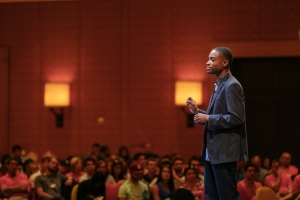
Last year, I had the honor of speaking at TEDx Brooklyn (video here) and TEDx Midwest (video coming soon). As an avid viewer of 100s of TED Talks, this was an amazing experience.
Every morning, I get on my exercise bike, choose a video on TED.com, and start riding and listening as it plays. It’s a great way to start my day—nourishing my mind and body.
After doing this for quite some time, I began searching for other sites like TED.com and here is what I found.
D.R.E.A.M. awake!
Here are some others people have shared since the original post:
Chicago Ideas Week
Academic Earth
I love playing with language, manipulating words, and even creating words like extra-average. Most dictionaries always have multiple definitions of words but at the end of the day, we give words meaning. When I was younger I used to rap and write poetry—that’s where my relationship to words began. Though I know and use many words thanks to the SATs, I made a commitment to be less loose with my language and become more intentional about what I say. I’ve come to realize that words have power and I want to mean what I say and be a man of my word.
So over a 30 day period, I decided to redefine the 20+ most important words to me that serve as the foundation of my life. Sometimes old language and meanings lock us into old ways of doing things. Forget Oxford. Forget Webster. I saw this as an opportunity to create language and thus new possibilities. I asked myself, what are the 30 most important words in my life and what do those words mean to me and only me?
Below you will find the results of my process which has completely shifted my life. Simply writing down my own definition of the word success for the first time changed how I move through the world. Once I became conscious of my own definition even if I can memorize it, it begins to inform my choices. All of my words below determine my choices whether I am conscious of my definitions or not so I might as well establish a relationship with them as well as begin to understand their relationships to one another.
If you choose to engage in this powerful process, I encourage you to choose the 10 most important words that are foundational to your life and define them for yourself in writing and see how you life begins to shift as a result of becoming aware of the meanings you choose to give them.
Purpose
Purpose is your ultimate reason why.
Failure
Failure is the moment we stop investing in something we believe in because of overwhelming and unwelcomed feedback.
Faith
Faith is being confident in the midst of an uncertain future.
Life
Life is a series of moments created by our relationships.
Leadership
Leadership is the act of creating more leaders.
Fear
Fear is simply information we may not want to hear or feel (but information nonetheless).
Time
Time is a space gifted to us by _________ (your spiritual source) to experience life as it is.
Comfort
Comfort is a seductive drug disguised as candy.
Enough
Enough is the point where the cost of getting one more outweighs the benefits of having one more.
Food
Food is any natural substance that energizes the mind, body, or soul.
Work
Work is the process of changing or moving an individual, organization, or thing from state (what it is) to state B (toward what it wants to be) or from point A (where it is) to point B (toward where it wants to be).
Health
Health is how we feel beyond the threshold of merely functioning.
Success
Success is the ability to:
1. be who you want to be
2. do what you want to do, and
3. have enough of what you need to continue being who you want to be and doing what you want to do
Help
Help is holding a door to an alternative path open as wide as you can for as long as you can for someone.
Trust
Trust is a currency backed by integrity (in the same way the dollar is supposed to be backed by gold).
Truth
Truth is every universal law within a defined universe.
Goal
A goal is a time-bound challenge to test our commitment and integrity.
Death
Death is the ending of any commitment, attachment, and agreement.
Money
Money is an agreed upon storer of value created in the past to facilitate easier exchange in the present.
Wealth
Wealth is a state of wellness and wellness is defined as peace of mind.
Gratitude
Gratitude is appreciation for what you already have.
Love
Love is the unconditional giving of one’s time and best energy.
Family
Family is anyone I choose to share time and presence with just because.
Wisdom
Wisdom is the ability to see what is true and name it.
Luck
Luck is favorable momentum that occurs when one moves in perfect alignment with their purpose.
Diversity
My next word to define…
What is gratitude?
Does it require receiving? Does it require giving? When is the best time to be grateful—in times of excess or lack?
Dictionary Definition
grat·i·tude [ grátti tud ]
1. thanks: a feeling of being thankful to somebody for doing something
Jullien’s Definition
Gratitude is appreciation for what you already have.
To appreciate means to increase in value. What we choose to give our time and attention/presence—our most valuable assets to—increases in value to us. It also works the other way around—what we value we give time and attention to.
Gratitude is less about receiving and more about giving (time and attention). If we didn’t receive anything else…if the world didn’t get “better,” could we and would we still be grateful? In this scenario, what could we be grateful for? We can only be grateful for what we already have—people, moments, memories, time, the food in front of us, laughter, joy, love, etc.
Gratitude can’t coexist with expectation or entitlement. They are future-based while gratitude is grounded in the moment…in the now. We use the language “Nobody deserves that,” when bad things occur to people, but in reality, nobody deserves anything…good or bad. The age-old question of “Why do bad things happen to good people?” is because “good people” don’t deserve anything for being good. If they want to be good, they should be good without expecting to get a smiley face sticker from God. I think they will find their lives are more joyful overall when they are “good” but there is no guarantee.
When we are too goal-oriented and focused on the future, we miss all of the “millionaire moments” that occur in our lives every day. Instead of being grateful for what we have right now and where we are, our time and attention is on what’s next. Anytime we leave the present, we leave a gift. We leave an opportunity to just be grateful. The more more more mentality may satisfy GDP (Gross Domestic Product), but there is another GDP to consider—Gratitude & Daily Positives. Being busy, takes us away from a mindset of gratitude because it is based in scarcity (e.g. not having a job, not being able to pay bills, not getting promoted, etc) rather than abundance (e.g. if I create value we all benefit).
There are tons of things to be grateful for now. A great place to start is by listing all of the things in our lives that didn’t have to happen, but somehow did. First off, let’s start with breath. There are some people who are literally on their last breath as you read this. Approximately 2 people die every second. Regardless of how tough life has been, would you prefer or not prefer to breath? What are all of the things that have happened for you that didn’t have to happen?
We can be grateful for what has happened or what hasn’t happened, but through my daily gratitude journal I’ve found that I’m most grateful for the things that I haven’t had any control over. First and foremost, I’ve come to realize that I have very little control over anything except my own thoughts, choices, and time, therefore, a lot of my life is an adventure. Moments will occur like bumping into an old friend, seeing a beautiful flower in the midst of a cement city, the sunset, receiving a beautiful thoughtful email written just for me from someone who was thinking of me, a new client calling out of thin air, or the ability to go grocery shopping and pay for healthy food. I’m also grateful for the few things that I do have control of because the world could work in a way where I didn’t and in some cases/places people don’t have control over those their thoughts, choices, and time.
I’ve been keeping a gratitude journal every day for months now. I take time to acknowledge and capture “millionaire moments” that occur for me. This daily practice has taught me a lot:
What we appreciate appreciates!
What is love?
Is love an emotion or an action? Does it require two people to generate or can one person have it? Why do we crave it?
Dictionary Definition
love [ luv ]
1. feel tender affection for somebody: to feel tender affection for somebody such as a close relative or friend, or for something such as a place, an ideal, or an animal
2. feel desire for somebody: to feel romantic and sexual desire and longing for somebody
1. like something very much: to like something, or like doing, something very much
Jullien’s Definition
Love is the unconditional giving of one’s time and best energy.
Love is an action. It is the action that initiated the Universe—our spiritual source did something it didn’t have to do and created the world and us. Whether the creation happened in 6 days, an instant, or is still happening in this moment, we have been left with the energy of the sun, food, thought, and heart as symbols of our Creator’s love for us.
Love has no expectation. It gives because it wants to give. When expectation occurs, it is a transaction or exchange as opposed to love. If we apply this to our “romantic” relationships where love is supposed to be at its height, it’s rarely the case. Many marriages, even those that weren’t arranged, are arrangements. Early relationships weren’t always based on love—they were based on family, community, work, and wealth. Are we certain that Adam and Eve loved each other or could we consider the first man and first woman an arrangement?
The reason our “romantic” relationships tend to be a strong source of love and space to give love is because we spend more time with our partners than anyone else. But time isn’t the only function—the second half of the equation is giving our best energy. The distinction between energy and our best energy is the distinction that is made between a store-bought gift that has no meaning and a thoughtful gift that specifically fits the individual we’re giving it to.
Energy comes and can be given in many forms:
- Presence: being with someone
- Attention: thinking of someone, even from a distance
- Action: doing for someone
I also like Gary Chapman’s 5 Love Languages which include:
1. Words of Affirmation
2. Quality Time
3. Receiving Gifts
4. Acts of Service
5. Physical Touch
Love requires sacrifice, but not in the sense that we lose ourselves. Love requires sacrifice, in that we put our individual interest behind the interest of the unit, which hopefully creates a greater possibility for all. In order for two wholes to come together, they don’t have to become half of themselves—instead, they just create a greater whole. If we lose ourselves in the practice of love, it isn’t love—that’s tolerance and conformity. Love helps us find ourselves in and through each other—that’s true connection.
When we seek love from a place of need or emptiness rather than wholeness, we can create a symbiotic or co-dependent relationship, but nothing new gets created in that situation, energy is only reallocated. While that can be a good thing, it isn’t love. Love transforms energy to a higher state as suggested by the first law of thermodynamics. But the second law also suggest that entropy or the tendency toward chaos is always present. Love’s energy counters entropy and keep things and people together.
The purest love always starts with self in the same way our Creator created us out pure love. We may think love comes from another person or place, but it actually emerges from within and then connects with the love in others. It is so beautiful when two people decide to give the gift of love to each other at the same time without knowing. It transcends someone giving a gift to someone else because they received a gift from them earlier. Self-love is simply an awareness of our power to:
1. create love
2. give love, and
3. receive love.
Each one of us has had a challenge with one of those three aspects, but a person who is truly in love with themselves can do all three.
To love thy neighbor as thyself implies that we must love ourselves first and that have the capacity to do so. It’s from the well of self-love that we are able to draw from and give love to others. Recognizing the love that has been freely given to us by our Creator through that initial act and emotion of creation is enough love to supply the world. And if we are made in God’s image, we have the powerful to create and initiate similar acts of love.
Love freely!
What is luck?
Who is lucky? And who isn’t? Is in random? Can we all access it? How can we be more lucky?
Dictionary Definition
luck [ luk ]
good fortune: success that seems to happen by chance
chance: the arbitrary distribution of events or outcomes
event determined by chance: something that seems to happen by chance rather than as a logical consequence
Jullien’s Definition
Luck runs on spectrum, not from unlucky to lucky, but moment-based luck to momentum-based luck.
Most people desire moment-based luck because it requires very little effort. This includes things like winning the lotto. It isn’t earned and it is random. But when unlucky moment-based situations occur such as losing a child, having a debilitating accident, or a house burning down, we’re less likely to welcome the other side of the coin. Either way the world is working against you-the lottery odds aren’t in your favor and the devil is out to get you. In both cases we have very very little control so it isn’t worthwhile to spend our time waiting or worrying about either situation.
Momentum-based luck is favorable momentum that occurs when one moves in perfect alignment with their purpose. In this case we have control of our choice to align or not align and our effort to work hard or not work hard. The Universe wants to and is working for you, always, especially in this case. We can know we’re experiencing momentum-based luck when synchronicity occurs often—we’re in the right place at the right time and all of the stars are aligning in our favor.
Because of inertia-the physical law that an object in motion tends to stay in motion or an object not in motion tends to stay not in motion-the hardest part of creating momentum is getting started.
Getting started is our responsibility and that can occur one of two ways. Either we listen for direction and then apply effort or apply effort in the direction we think is best and then bases on internal feedback from our source make changes in direction.
There is a fine line to acknowledge. All momentum isn’t good momentum, but it easy to mistake. Sometimes we perceive things as lucky that are actually unlucky. Our source may loving accelerate us in the wrong direction to get us going in the right direction. Sometimes we have to go backward to go forward. Our source may give is more of what we think we want until the law of diminishing returns kicks in and we realize that having excess of something doesn’t fulfill us, which leads u on a quest for what does. It’s tough love.
Luck is like yeast, it’s something we can all access to help us grow if we align our effort with out purpose which is the will of our source. Anytime you feel the universe is working against you, receive it as a cosmic nudge suggesting “there is am easier path that would allow me to help you gain more of what you want. You can call it luck, I call it you.”
Consider yourself lucky!
What is family?
Is it biological or broader? How big is your family? Who would you go the extra mile for? What’s the difference between family and friends? How fast can someone become family?
Dictionary Definition
fam·i·ly [ fámməlee ]
1. group of relatives: a group of people who are closely related by birth, marriage, or adoption
2. people living together: a group of people living together and functioning as a single household, usually consisting of parents and their children
3. lineage: all the people who are descended from a common ancestor
Jullien’s Definition
Family is anyone I choose to share time and presence with just because.
I’m going to use a child with a single-parent or no parents to demonstrate my thoughts.
First, I think family is a choice, not a consequence. Just because someone gave birth to and biologically they are your mother or father, they may not have played the role of mother and father. Unfortunately, that was their choice. In the instance where both parents aren’t present, youth may find family in aunts, uncles, grandparents, or foster parents.
Second, I think time and presence is a requirement. Time is the greatest gift we can give because it is our most valuable resource. However, just because we spend time with someone doesn’t mean that we are fully present. A child brought up by a single-mother because their father wasn’t present by his choice shouldn’t keep the father’s last name. The man who fathered them is not family. But the same case can be made for a busy business man or woman who chooses their career over their children. In these instances, sometimes the most affection comes from the nanny.
Third, I think time spent with family doesn’t require a reason. We spend it just because. The original intent is not a transaction, though transactions that involve various types of currencies—love, money, advice, support, feedback—may occur. Business may be characterized mostly by transactional relationships, but with family, our presence and their presence is the gift and it is more than sufficient.
We’ve been taught that our biological family and nuclear family is it, but my definition has expanded to include people who don’t fit that criteria. I welcome this notion of Framily (=Friends + Family) because I think it takes the biology out of the word family. In all honesty, there are “friends” that I consider to more family than many of my biological family members. If family and familiar share meaning, then there are definitely people who know me better than my family.
When my definition of family—who I love, who I care about, who I make time for—expands, so do I. When it is limited to preconceived notions, I shrink.
May your love and family grow!
What is wisdom?
How do you gain it? Does it come with age and education? Is it synonymous with knowledge?
Dictionary Definition
wis·dom [ wízdəm ]
1. good sense: the ability to make sensible decisions and judgments based on personal knowledge and experience
2. wise decision: good sense shown in a way of thinking, judgment, or action
3. accumulated learning: accumulated knowledge of life or of a sphere of activity that has been gained through experience
Jullien’s Definition
Wisdom is the ability to see what is true and name it.
Wisdom transcends knowledge. Whereas knowledge is the memorization and manipulation of facts, figures, and frameworks, wisdom is the in-the-moment intuitive differentiation between whats fake and real, essential and non-essential, core and non-core. It cuts through the b.s. and goes straight to the heart of the matter.
It can only be acquire by listening. Listening comes in many forms- hearing beyond words, reading, self-observation and self-examination, meditation, being still, writing (without the intent to prove a point), non- judgmental observation, and prayer among others. Most people think that because they are able to hear that they are listening, but that usually isn’t the case. Most of us hear to talk or are here to talk because we think we have wisdom and are right.
In fact, wisdom is never about right or wrong. It never points down one path and says this is the way we must go. Instead it takes those who listen back to the crossroad where they are able to make the best choice for themselves. Wisdom provokes more questions in an individual than answers. It helps us see ourselves and make new choices from a new perspective and pair of eyes.
Oftentimes it is assumed that elders have a monopoly on wisdom. That’s not true. If wisdom is derived from the act non-judgmental observation of self or others to listen and look for whats true, then anyone can access wisdom the moment the are able to step outside of themselves (as the center of the world) and see it as it truly is.
As babies we are self-centered and the world does appear to revolve around us. Cry and you will get what you want. As children we oftentimes see the same self-centeredness with “my toys.” But for many adults, this me-centered world never leaves, so they cut themselves off from being able to rise above their own beliefs and assumptions and see the unbiased truth.
The expansion of education, even higher education, hasn’t led us to more wisdom. In fact, by emmersing us in more an more facts, in many ways it has drowned wisdom out. Anytime a course is graded based on a right answer rather than a insightful answer, wisdom will not emerge.
Wisdom is the ability to see a multiplicity of possibilities or ways to look at a situation and solve a problem. It’s the realization that there is no one way or right way—there may be easier, faster, or shorter ways that work for us, but that doesn’t make them universally right. A wise person can suspend judgement and listen to their intuition and others.
The wise see otherwise!
What is diversity?
Is it having enough people of color on your staff? Is it ensuring gender equity? Is it actually thought-based and not physical?
Dictionary Definition
di·ver·si·ty [ di vúrssətee ]
1. variety: a variety of something such as opinion, color, or style
2. social inclusiveness: ethnic variety, as well as socioeconomic and gender variety, in a group, society, or institution
3. discrepancy: discrepancy, or a difference from what is normal or expected
Jullien’s Definition
What is wealth?
Am I wealthy right now or not? Is there a threshold? Is it a feeling or a finite possession? Is it relative or universal? Is it about how much you give or how much you keep?
Dictionary Definition
wealth [ welth ]
My Definition
As I scoured the internet, it seems that the etymology of the word wealth from the old English wela, which is from an Indo-European word stem. I found various meanings for wela from love, joyous, return, skill, and a bownet for catching fish. But to be even more simple, we can just look at the word well.
Wealth is a state of wellness and wellness is defined as peace of mind. Peace of mind means having faith in stead of fear, healthy competition versus cut-throat competition, a mindset of abundance rather than scarcity, having support instead of standing alone, and love rather than hate.
Instead of being measured in material possessions, it’s best measured is matter-real possessions (or possessions that really matter). This connects with my third criteria for success which is having what we want to have. They say that the best things in life free. I don’t fully agree with that. I do believe that the best things in life can’t be bought with material possessions—love, peace, happiness, family, passion, purpose.
I don’t think wealth is about how high our money stacks. I think it’s about how deep our well runs. Many people stack material possessions out of fear of loss and a mindset of scarcity. The alternative is a mindset of abundance that trust in the Creative Spirit that created us to provide in the same way it provides for every other living thing. Someone living in fear is not well. Oftentimes, we seek material wealth in attempt to squeeze out God. The U.S. dollar reads “In God we trust,” but on countless occasions throughout history, human beings have come to worship the streams through which The Source flows more than The Source itself.
A few Native American tribes engaged in a ritual call potlatch, which we know today as potlucks. At potlatch gatherings, a family or hereditary leader hosts guests in their family’s house and holds a feast for their guests. The main purpose of the potlatch is the re-distribution and reciprocity of wealth. Sponsors of a potlatch give away many useful items such as food, blankets, worked ornamental mediums of exchange called coppers,” and many other various items. In return, they earned prestige. To give a potlatch enhanced one’s reputation and validated social rank, the rank and requisite potlatch being proportional, both for the host and for the recipients by the gifts exchanged. Prestige increased with the lavishness of the potlatch, the value of the goods given away in it.
Wealth was defined by how much you gave away, not how much you kept for yourself. And we see trends shifting in this direction today. Bill Gates and Warren Buffet have convinced 40 billionaires to give away at least have their wealth in their lifetime (See the list). In addition the Bill & Melinda Gates Foundation Trust has committed to spend all of its money within 50 years of their deaths and Buffet’s Berkshire Hathaway shares that he still owns at death are to be used for philanthropic purposes within 10 years after his estate has been settled. Mark Zuckerberg and others who are part of the new rich have also made commitments to give away their wealth in their lifetime. This notion of old money being held and passed down from generation to generation is dying and a mindset of giving (now) is emerging.
Each of us has a well with water in it. Ironically, the more we give, the deeper the well runs. Our wealth and our wellness depend on how much we give. Therefore, giving is wealth in action.
What is help?
When is help needed? How should it be given?
Dictionary Definition
help [ help ]
1. assist somebody: to make it easier or possible for somebody to do something that one person cannot do alone by providing assistance
2. advise somebody: to provide somebody with advice, directions, or other information
3. be useful: to make something easier or more likely
Jullien’s Definition
Help is holding a door to an alternative path open as wide as you can for as long as you can for someone.
True help strengthens rather than weakens. It’s goal is self-sufficiency, not unnecessary dependency. Though I think that life is interdependent, I also think that there are areas where we should be self-sufficient. Oftentimes we help according to what we think is best for someone. But how do we know? Here’s a short story that captures how we can hurt people even when our intention is to help them.
So how can we help better? We can hold the door to an alternative path open as wide as we can for as long as we can. In doing so, we allow the people we want to help to window shop-to peak in and do their own cost-benefit analysis.
The costs include:
-changing a comfortable behavior
-the time & energy cost of the new behavior to get at least the same result they were getting before
- the time it takes to get back to at least where they were using the old way
- the time & energy cost to sustain the new result (ie going to the gym 4x per week and waking up earlier)
- any financial cost (ie gym membership)
- social cost or hard to accept changes in perception of and relationship to self and friends
These are where the most excuses come from and the reasons procrastination occurs.
The benefits include anything that brings them on closer proximity to what they want or their DREAM (Desired Relationships Employment And Money).
1. Does your help improve their relationship to themselves, family, friends, colleagues, community, strangers, etc?
2. Does your help allow them make a more meaningful and unique contribution through work?
3. Does your help move them in the direction of financial freedom?
Ultimately they have make the choice. Education, not persuasion, is the tool.
Helping others is how we create value for the world and ourselves. But we can only give someone what they want. So help starts with listening to those we want to help, not telling. What’s best for us is not necessarily what’s best for someone else. Only I can determine what is best for me and what’s best for you may not be what’s best for me. So true help closes a gap between where/who someone is and where/who they want to be. The helpers exhibit unconditional love by being there to help without expectation for the people they are helping or unrequested influence on what the people need or want. Love is being there just because.
When I ask young people what they like doing, most say “I like to help people.” That’s great but it’s only the beginning. The next questions are:
1. Who have you helped?
2. How do you think you helped them? How did you help move them from some point A to some point B?
3. Did you enjoy helping in that way? Did you help with love?
4. Who else could use this kind of help?
5. How could you help in a deeper way?
I think that the purpose of this inherent desire to help is to foster our interdependence and the beauty it creates when your strength makes up for my weakness and my strength makes up for yours. The desire to help shifts us from selfishness to selflessness. My greatest moments in life have occurred when I really helped someone or someone really helped me. It’s such a gift and gifts can only occur when there is a gift giver and a gift receiver (who may also be a gift giver too). Without help, we would only be half of who we are because we have accomplished more together than we have alone. Our desire to help allows us to see our power, our purpose, and ourselves in one another.
Most arguments as based on the definition of one word…education, democracy, love, marriage, moral. If we can’t accept or articulate each others definitions, we cannot come to an agreement.
What is trust?
What’s the difference between trust and expectation? Are trust and expectations correlated? Do they have to be? Can you trust somebody? Why is trust so hard to develop and easy to lose?
Dictionary Definition
trust [ trust ]
1. reliance: confidence in and reliance on good qualities, especially fairness, truth, honor, or ability
2. position of obligation: the position of somebody who is expected by others to behave responsibly or honorably
3. hope for future: hopeful reliance on what will happen in the future
Jullien’s Definition
Trust is a currency backed by integrity (in the same way the dollar is supposed to be backed by gold).
In God we trust. I trust you. I trusted you. I don’t trust you anymore.
Our entire social system is based on trust-based social contracts. I trust that I will be able to spend this money I earned to get other goods and services. I trust that if I loan you this money, you will give it back. I trust that you won’t steal what is mine. I trust that if I do what I’m told I will get the maximum result or reward. I trust that if I marry you, you won’t hurt me or cheat on me. I trust that you will protect me and take care of me. I trust that you will do what’s right. I trust that you tested this and it is safe.
There is a fine line between trust and expectation. When we begin to expect certain behaviors or things from God (God, if I do this, you’ll give me…), other people (If we get married, you’ll never…), and ourselves (I will always…) and they don’t come as expected, oftentimes we lose trust. In reality, we settled into an expectation of “I’ll always… You have to. You’re supposed do. I deserve. You should have…I’m entitled to.” All of these expectations are false and when what happens doesn’t align with our expectations our trust waivers.
Expectations occur when we expect someone to do something they didn’t necessarily commit to simply because of past behavior. For instance, someone can think to themselves “I’m sure she’ll loan me a few dollars” when “She” never made that commitment. Her past behavior may indicate that it is likely in the future, but each time is an individual choice. Expectations don’t give the individuals we interact with the freedom to make new in-the-moment choices even in seemingly similar reoccurring situations.
Trust is the space an individual holds for themselves or others to deliver on something they committed to. We can only base trust off of one’s integrity or the alignment of their word and action. If someone commits to something that you are depending on in the future and they don’t come through, then trust is broken (unless a crazy circumstance occurred). Trust that someone will do what they say in the future allows us to focus on other priorities and move in a different way mentally, physically, and spiritually. Therefore, violation of that trust throws off our future. Oftentimes, it would have been easier to move through the world if the other party (or ourselves) just said “No” from the beginning.
Every day we create agreements and contracts with other people. “I’ll call you later. Let’s do lunch next week. I’ll email you. I’ll see you later.” But most of the contracts are loose and cordial. But even those small commitments are times to build trust. Even the legal world where contracts are written and signed, most contracts are distrust-based. They are designed to protect both parties from major downside rather than establishing clarity around a new relationship that will create upside for everyone. In the cases where the contracts are trust-based (I’ll do A and you’ll do B in hopes that we can achieve C together), new trust is created when the desire goal is achieved and with more trust comes more opportunity.
Verbal and written contracts actually shift expectations to trust because now their is a commitment from the other party saying “Yes! I will do that for you.” Most expectations are imagined and unwarranted—we assume that the other party should know they are supposed to do that. Getting the expectations we have of others out of our heads by verbalizing them with the parties we have expectations of will allow us to see which one’s are justified and unjustified, and from there we can build more trusting relationships.
In (the) God (in you) I trust!